
Chessreps says it's cheaper and better. I checked.
· Marcus Buffett
Chessreps has been spending a lot of money advertising recently, and they haven't hesitated to take shots at us (Chessbook):

Normally I wouldn't criticize any non-Chess.com-owned chess site, but if they're going to come after us then I feel it's fair to hit back.
Let's learn a course on Chessreps
For the sake of fairness I'm not going to cherry-pick a course here, I'm just going to pick the very first one in the list, and we'll go through it. It's an Italian course by Grandmaster Wei Yi. Let's check whether it covers the essential replies like it claims, whether it's better than a generated Chessbook course, whether it asks you to memorize any lines that won't be useful at your level, if Wei Yi himself has ever played any of these lines, and more.
The course is called "The Italian Game". It has 122 lines, 30 of them marked as "Essentials" to learn first. It meets 3...Bc5 with 4.c3 and 5.d4, meets the Two Knights with 4.Ng5, and promises "a punishment for every Black sideline."
I'm rated around 1600–1800, so that's the level I checked it at. Every number below comes from Lichess games between players at that level, and I've linked the positions so you can check them yourself.
The only free line
Chessreps lets you play one line of each course for free. For this course, it's the Fried Liver: 4.Ng5 d5 5.exd5 Nxd5 6.Nxf7 Kxf7 7.Qf3+ Ke8, and you take the knight on d5 for free.
It's a good first impression. You sacrifice a knight, chase the king, and win a piece on move 8. It feels good. But you'll reach it in about one in 200 of your games as White, and this is all you get without paying. So let's sign up for the free trial and see how that goes.
My cofounder and I have gone back and forth on how much we should give away on the free plan. 100 moves, 150 moves, 75 moves... Suggesting we give free users one single line would have gotten me laughed out of the room.
Where's the cancel button?
Chessreps says you can cancel any time, so I went to the billing section in settings to see how. There's no cancel button there:
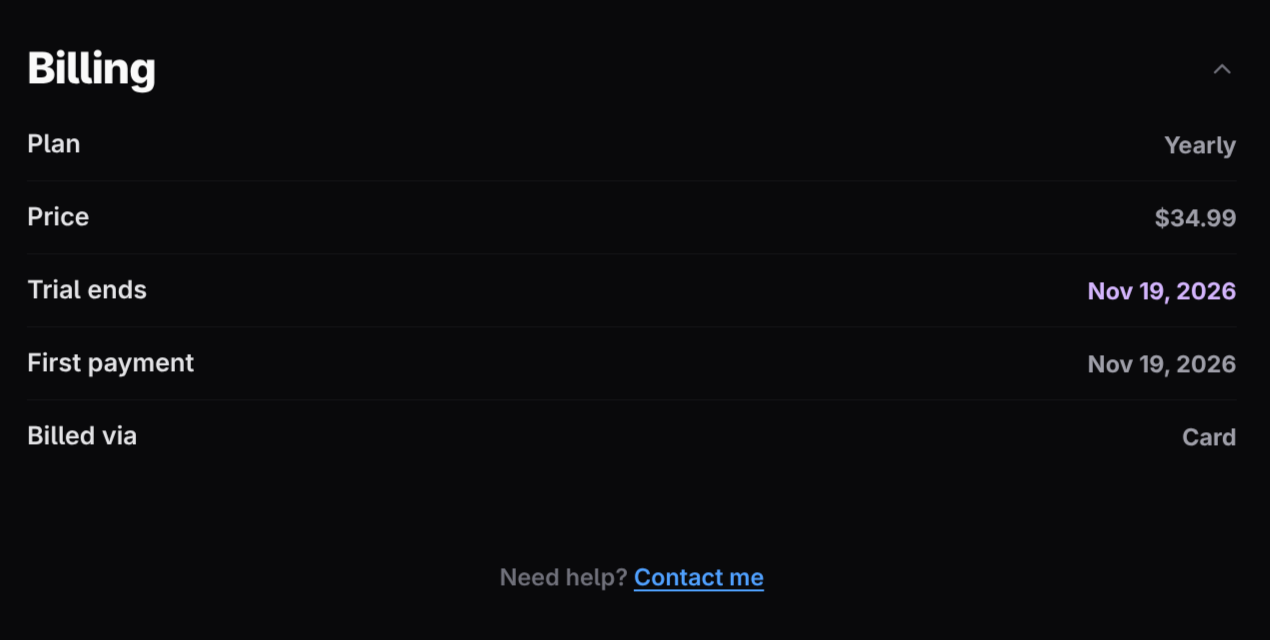
It turns out cancelling is buried under "More settings", somewhere else entirely. Nice retention trick, Chessreps. I'm sure we'd have a lower churn rate if we made it harder for people to cancel their subscriptions too.
Anyway, back to the course.
Does it cover the essential replies?
Here's how Chessreps describes its courses in its FAQ:
Grandmasters and other titled players write the titled courses, and Chessreps checks every course against real Lichess games. Any reply that players choose in 1% or more of games from a position counts as a gap until the course answers it, and authors keep adding lines until the common replies are covered.
That's a reasonable rule. I applaud Chessreps for looking at coverage like this. It's something no one was doing before we did, and it's undoubtedly the better way to view coverage of a repertoire. But it has to be by rating range to be useful. And either way, the course doesn't meet it.
There's no single giant hole. The biggest ones each come up in roughly 1 in 300 of your games as White. But they add up: in 68% of Italian games, your opponent plays a reply that Chessreps' own rule says the course should answer, and it doesn't, either inside a line or where a line simply stops.
The worst hole is the Ulvestad. After 4.Ng5 d5 5.exd5, about 5% of players at this level play 5...b5, and White players score just 42% against it. The course has no answer. It gives you eight lines against 5...Nd4 instead.
So the course teaches you a trap you'll see in about one in 200 games as White, because it wins a knight and makes you feel good. Its holes come up about as often, and they're where you lose. It turns a blind eye to the lines that go badly, so it feels like you only ever reach winning positions.
The course's blurb promises:
A classic that still wins games: pawns to c3 and d4 for the center, knight to g5 against the Two Knights, and a punishment for every Black sideline.
Here are some of the replies it has no answer for, every one of them played in more than 1% of games from its position:
- 3...Bc5 4.c3 a6, about 1 in 80 Italian games
- 3...h6 4.d4 exd4 5.Nxd4 Ne5, about 1 in 80
- 7.Nbd2 d6, in the course's own main line, about 1 in 100
- 7.Nc3 Bxc3+, about 1 in 130
- 3...Bc5 4.c3 Qf6, about 1 in 145, where White scores 47%
- 8.Qf3 h6, in the 5...Na5 line, about 1 in 165, where White scores 46%
- 3...Bc5 4.c3 Nge7, about 1 in 180
A Chessbook repertoire built for this rating range answers every reply this common in its own lines.
When I imported the course into Chessbook and graded it at a modest coverage goal (1 in 200 games), it found three holes: the Ulvestad, 4...Qf6, and 8...h6 in the 5...Na5 line. In all three, White players at this level score under 50%. At a thorough goal (1 in 800 games), it finds 20.
Will you ever play these lines?
Now the other direction: lines the course asks you to learn that you won't see.
The very first Essential is 4.c3 Nf6 5.d4 exd4 6.cxd4 Bb4+ 7.Nbd2 Nxe4 8.d5 Bxd2+, and onward for 27 plies to 14.Rg1. In every blitz, rapid and classical game on Lichess between players rated 1600–1800, nobody has reached the end of that line. The deepest position any game reaches is three plies earlier, and exactly one game gets there. The third Essential is longer still, 35 plies, ending 18.Bf1. Three games get to ply 30. None go further.
Across the whole course:
- 40 of the 122 lines end in a position that no 1600–1800 game in our data reaches.
- 76% of games never reach the end of any line in the course. Half the time you're out of it by move 7.
- You're asked to learn 381 White moves, and in a typical game you'll actually play about 4.5 of them.
To be clear, the course isn't unsound. I checked every White move against Stockfish and none of them loses a pawn. The problem isn't the moves, it's where the effort goes: deep lines nobody reaches get a lot of attention, while common replies that score badly for you get none.
Is it better than a generated Chessbook repertoire?
To compare fairly, I had Chessbook's autofill build an Italian repertoire from the same position (after 3.Bc4), at the same rating range, and graded both the same way. Win rate here is White's score in 1600–1800 games that reach the Italian, counting only the difference your own moves make.
On the default settings, the autofill repertoire is about half the size, has no holes, and gets a 62.6% win rate against the course's 58.8%. The average player at this level scores 52.1% from here, so that's 10.5 points of improvement for the Chessbook repertoire and 6.7 for the course.
Building it took about a minute.
How long does it take to learn?
This is where the difference gets big, and it's because of how Chessreps schedules your reviews.
Chessreps uses FSRS, the same family of spaced repetition algorithm we use. The difference is what gets scheduled. In their words, "Chessreps uses FSRS to schedule whole lines that you replay from the first move." Every time a line comes up for review, you play every White move in it again.
That adds up. To review every line in this course once, you play 1,234 White moves to rehearse 381 distinct ones. You play 1.e4, 2.Nf3 and 3.Bc4 122 times each. And when you miss one move deep in a line, the whole line gets rescheduled, not just the move you got wrong.
Chessbook schedules each move on its own. When a move is due, Chessbook plays the line up to it for you, and you play just that move. The moves you know drop out of your reviews, and the one you keep missing comes back.
Say a move needs five successful reviews before it sticks, the same on both sites. To learn the whole course, you'd play 6,170 White moves. To learn the default Chessbook repertoire, 985. That's 6.3 times as much practice, for a lower win rate.
Here's what that looks like as time. Each blue point is a Chessbook autofill repertoire at a different coverage goal, from a small one to a very deep one. Together they make the Pareto frontier: for each amount of study time, the best win rate we found. The orange points are the Chessreps course.
Learning the full Chessreps course takes about 12 hours of practice and gets you to 58.8%. Chessbook gets there in about 18 minutes. Obviously, these 12 hours and 18 minutes are spread over weeks of spaced repetition study in each case. The course's 30 Essentials alone take almost three hours, for 57.9%; a 23-move Chessbook repertoire gets the same in about 13 minutes.
I used 7 seconds per move because that's the average time between reviews on Chessbook, including watching the line play out. Replaying moves you already know is probably quicker than that, but even at 3 seconds a move, the course is over five hours. The exact hours depend on how fast you play and how many reviews a move takes. Those assumptions are the same for both sites, so the gap doesn't move.
Has Wei Yi ever played these lines?
The course is written in the first person as Wei Yi. So I looked at his games as White after 1.e4 e5 2.Nf3 Nc6 on chessgames.com:
- He plays the Italian (61 games) about as often as the Ruy Lopez (69).
- The course's main weapon, 4.c3 and 5.d4 with 6.cxd4 Bb4+, appears in three of his games, all from 2012 and 2013. In all three he played 7.Bd2. He has never played the course's 7.Nbd2.
- Since around 2016 he's played the slow d3 Italian almost exclusively, which the course doesn't teach.
- He's played 4.Ng5 against the Two Knights in three classical games, and never the Fried Liver.
In fairness, the course intro says it's going to show "interesting yet highly challenging side variations", not his main repertoire. But if you bought it thinking you'd learn how Wei Yi plays the Italian, you won't.
What happens after you've learned it?
Learning the moves is half the job. The other half is finding out whether they show up in your games, and whether you remembered them.
Chessbook connects to your Lichess and Chess.com accounts. Moves you play correctly in your games count as reviews, and we flag the moves where you left your repertoire. If you play on Lichess, we watch your games live, and the moment a game ends we can tell you whether you played your opening correctly. We build opening reports from your games, so you can see which openings you do well in and which ones are costing you. You can write your own notes on any move, and export your repertoire as a PGN whenever you like.
I couldn't find any of that on Chessreps. There's no mention anywhere on their site of connecting your Lichess or Chess.com account, no reports on your own games, and no PGN export. The notes are the author's; to write your own, you have to copy the course into their course creator. And the course is the same for everyone, whatever your rating.
Prioritizing engagement over learning
Which brings me to the bigger picture. Look at how Chessreps describes its own features:
- Drill keeps a streak going across your lines.
- Time Trials race a 60-second clock that speeds up as you score.
- Weekly, monthly and all-time leaderboards for both.
- An Arena rating for every course, starting at 950.
- A 15-minute countdown on the pricing page telling you your free trial is "reserved".
None of that is evil. Streaks and leaderboards are fun, and fun keeps people coming back. But those are the levers you pull when what you're measuring is time in the app. If you're measuring how prepared someone is for their next game, you build something different: fewer lines, aimed at the replies they'll actually face, and reviews spent on the moves they're about to forget.
Replaying 1.e4 for the 122nd time is good for engagement. It isn't good for your chess.
The pricing follows the same pattern. On Chessreps, you get one line of each course, then a 7-day trial that rolls into a $34.99 annual subscription. On Chessbook, the free plan includes your 100 most common moves for each color, with full spaced repetition. About 80% of our users never pay, and a lot of them don't realize there's a paid plan at all. We regularly get reviews calling Chessbook a free tool. I'm fine with that.
So, is it worth it?
Their ad says Chessreps is "literally just cheaper and better", and promises you'll "explode your ELO" in 7 days.
Is their annual plan cheaper than ours? Yes. But you don't need to pay us anything to beat this course. A 58-move Chessbook Italian repertoire fits easily in the free plan's 100 moves, gets you a 60.5% win rate against the course's 58.8%, and takes about half an hour of practice to learn instead of twelve hours.
So do you want to pay $35 a year for a course that takes at least six times longer to learn, and gets you worse results?
Frequently asked questions
Isn't 1600–1800 cherry-picked?
It's my rating, and it's a very common one. The course is the same for everyone, so at other levels it will miss different replies and teach different lines you won't reach. I'd expect the same pattern.
Is the course bad chess?
No. The moves are sound. The problem is that the effort goes into lines you'll rarely reach, while common replies go unanswered, and the review system makes you replay everything you already know.
How did you measure all this?
See the notes below.
Stats for nerds
- The course: all 122 lines from the Chessreps line picker, taken on November 12, 2026.
- Lichess numbers: the Lichess opening explorer, Lichess games, 1600 rating band (1600–1799), blitz, rapid and classical. "1 in N Italian games" multiplies Black's reply shares along the course's own moves after 3.Bc4. I didn't divide raw game counts, because those include games where White played something else.
- Win rates: Chessbook's effectiveness formula. Each of your moves gets credit for how much better White scores after it than at the position before, at 1600–1800, shrunk toward the position before when there are few games. Measured over games that reach 1.e4 e5 2.Nf3 Nc6 3.Bc4.
- Holes: Chessbook's grader, at coverage goals of 1 in 200 and 1 in 800 games.
- 68% of Italian games: the share of games, weighted by how often each happens at 1600–1800, that leave the course through an opponent reply played in at least 1% of games from that position.
- Time to master: five reviews per move and 7 seconds per move played, for both sites. 7 seconds is the mean gap between a user's consecutive reviews on Chessbook over two days in November 2026 (about 250,000 reviews, gaps of 1 to 120 seconds). Chessreps replays whole lines, so one pass over the course is 1,234 White moves.
- Wei Yi's games: chessgames.com, which includes rapid and blitz games.
- Chessreps' features: from chessreps.com and its App Store listing, as of November 2026. "Not that I could find" means none of their pages mention it.